



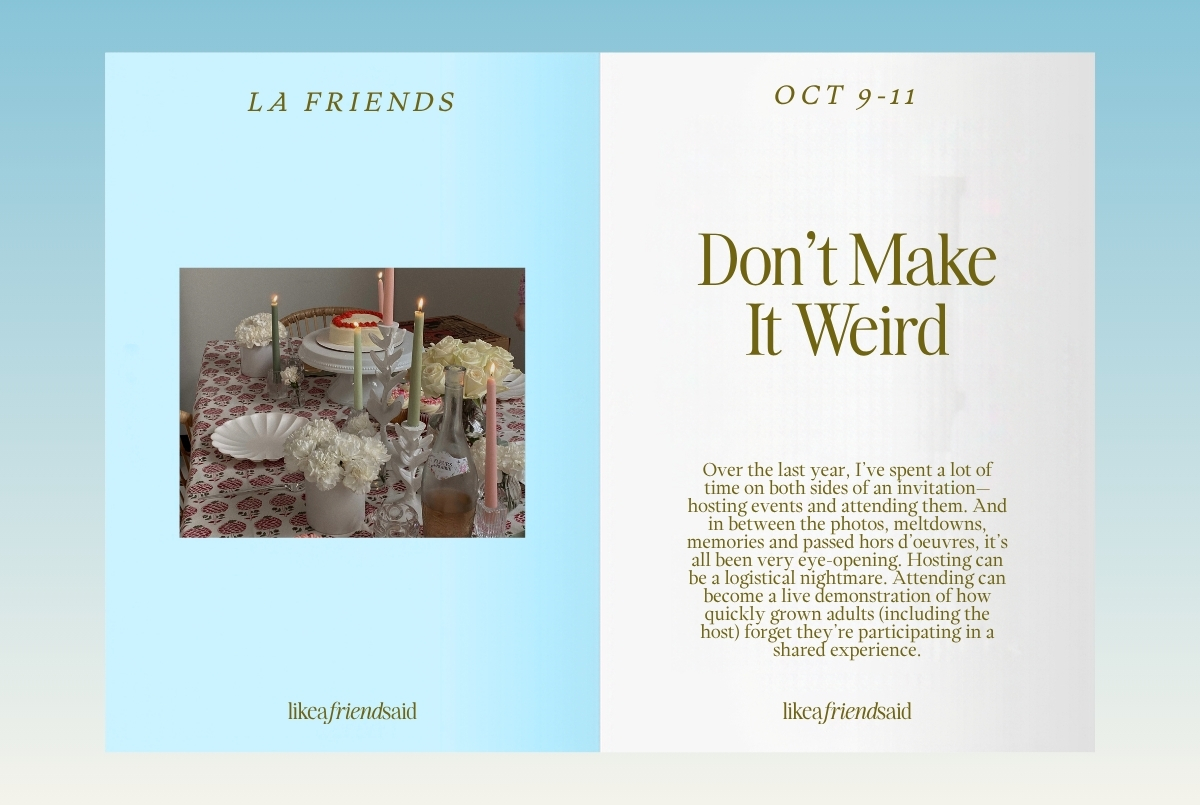
Over the last year, I’ve spent a lot of time on both sides of an invitation—hosting events and attending them. And in between the photos, meltdowns, memories and passed hors d’oeuvres, it’s all been very eye-opening. Hosting can be a logistical nightmare. Attending can become a live demonstration of how quickly grown adults (including the host) forget they’re participating in a shared experience.
And before everyone starts pointing fingers at Gen Z or millennials: some of the most startling offenses I’ve witnessed (from both hosts and guests) have come from older generations. You know, the very people who worry we’ve forgotten how to socialize because we look at our screens too much.
Questionable event etiquette is one of the few truly intergenerational experiences we have left.
I’m not talking about knowing which fork to use or archaic rules like not wearing white after Labor Day (we’re still honoring the LA sunshine by rocking our white linen into October and I love us for it). I’m referring to the small things. The basic courtesies—that are no longer so basic—that acknowledge someone has spent time, energy and likely money bringing people together, and that everyone attending contributes to the overall feel of a gathering. In return, guests deserve to feel considered, comfortable and clear on what they’ve been invited to.
We’ve gone from handwritten invitations in gorgeous cursive to blasted Partiful e-vites followed by “sorry, just seeing this” responses five weeks later. We’ve gone from charming weddings filled with love and zero social media influence to brides running their larger-than-life day like a military operation—with an unhinged planning deck that includes when members of the wedding party may or may not conceive a child (we’ve all seen these TikToks and we all know at least one person who has been or would be that bride).
This applies to weddings, birthday dinners, dog birthday parties, housewarmings, dinner parties, girls’ nights, networking events and any excuse we make to drink together. All hosts have a responsibility to make people feel considered. And all guests have a responsibility not to become another logistical problem for their hosts. It sounds like a very simple and harmonious relationship. However, the details have become a little blurry.
I’m not claiming to be Emily Post, but recent events have inspired me to revisit some basics. In no particular order...
- Guests: please, for everything you hold holy, RSVP. If someone took the time to invite us anywhere, the least we can do is respond without making them chase us. And if we can’t attend, acknowledging the invitation to let them know is just as important. A warm “I’m so sorry I have to miss this” takes thirty seconds and feels infinitely better than silence. When a host is juggling food, drinks, timing, seating and their rapidly declining will to live, the last thing they want to do is add chasing people for an RSVP to their endless list of to-dos. And if we’re talking about a large event, I guarantee you this can be a direct threat to their sanity.
- Hosts: feed your guests. This may sound obvious to most people, or so I thought, until a close Friend hosted a “girls’ night in” and insisted she didn’t need to put out food for an 8pm gathering because, in her exact words, “Everyone will have already eaten dinner.” Alarming? Yes. Clueless? Absolutely. And I lovingly told her so while frantically DoorDashing anything available within a one-mile radius. In her defense, she is strictly a 5pm-dinner kind of woman. I’m not saying you need to prepare a six-course meal from the latest New York Times recipe of the week, but if people are spending several hours in your home, have literally anything edible to offer them.
And while we’re in this neighborhood of basic necessities, remember to keep your guests’ general comfort in mind. If you’re an alien like me who prefers the thermostat at a crisp 79 degrees, remember that most human beings do not, and heatstroke is a terrible party favor. Plus, a room full of people gets hot and stuffy fast. And don’t forget the non-alcoholic drink options for our sober Friends! - Guests: don’t assume you have a plus-one. This is especially true for weddings, where every additional guest affects the seating chart, total cost and a carefully negotiated headcount. After serving as a bridesmaid and maid of honor more times than I can count, I’ve heard enough stories about RSVPs reading, “I’ll have the steak. Simon will have the fish,” and couples asking the only question they can: who the fuck is Simon? Unless you’re close to the couple, don’t ask them to revisit the guest list for someone they’ve never met.
The same applies to events at someone’s home or a restaurant dinner the host is generously treating everyone to. They’ve planned the food, space and cost around a specific headcount that likely doesn’t include your surprise expansion pack. If you’re close with the host, feel free to ask, but do so before your mystery guest is dressed and suffering through traffic on the 110 (and be prepared to graciously accept no). The same goes for children, pets and anyone else you’re considering adding to a headcount that was carefully calculated without them. - Guests: timing matters. I was raised to believe arriving early at someone’s home is rude. And after scrambling to finish setting everything up while fully dressed guests stand nearby watching me run around while very much not dressed yet, I understand this anxiety-ridden logic now as an adult. Assume your host is squeezing in the quickest military shower, hiding clutter and transferring store-bought dip into a bowl. Arriving five or ten minutes late is a beautiful courtesy.
The major exception is a wedding: get there early and follow every transportation instruction provided. For networking events, it comes down to personal strategy. Arriving before the room fills can make meeting people much easier—or give you extra time to stand alone questioning why you challenged yourself to “put yourself out there.”
- Guests: let’s bring back the hostess gift, but with limits. If I have to watch one more video about how chic it is to have a “signature hostess gift”.... But annoyingly, their point remains: a small gesture never goes out of style. Just make sure you bring something that doesn’t require work for the host, like wine, chocolates or a candle. It shouldn’t come with the pressure of serving it to everyone that night. Instead, bring something the host can enjoy on their own after everyone leaves and the house is finally quiet. And it should not be flowers unless they’re already cut and arranged in a vase. A bouquet wrapped in paper is not a gift; it is a surprise project you’ve given the host that involves stem trimming and finding a vessel while dinner burns.
- Guests: only report real dietary restrictions. Of course, hosts and caterers need to know about allergies, intolerances and medical or religious restrictions. They do not need a file on every food you dislike. The caterer serving 200 guests does not care that mushrooms aren’t your favorite. And now you’ve left the host spending the final weeks calling everyone to determine whether a mushroom will literally kill you or just disgust you. I promise you it’s as fun as it sounds.
- Guests: make an effort to participate. Put your phone away and talk to the people around you. On The Morgan Stewart Show, Tinx painted a bleak picture of influencer dinners where the women around her never looked up from their phones and seemed miserable to be there. Her point was simple: the least you can do is help make it fun for everyone.
Don’t know anyone else? Never let that be the thing that keeps you from going or putting in the effort! Some of the best Friendships and opportunities in my life came from being uncomfortable in a room where I knew literally not one other soul. I truly mean it every time I say that most of life is just having the guts to show up. Introduce yourself, ask questions and definitely approach someone else who’s standing alone. And then the two of you can pick up the next person you see standing alone and slowly build a group for all the other brave souls who came alone. Fortune favors the bold, and sometimes the gutsiest thing you’ll do all week is walk into a room solo and introduce yourself.
- Hosts: be clear up front about cost expectations. At a restaurant, are you treating everyone? Are guests paying for themselves? Are you splitting that bill? If you choose an expensive restaurant, don’t be offended when someone opts out and makes separate plans with you instead. And if you’re organizing your own birthday dinner, don’t automatically expect your guests to pay for you. It’s a lovely gesture when they offer, but not a financial obligation hiding under a birthday candle. Make sure everyone knows what they’re agreeing to before that check arrives.
- Guests: follow the dress code. Your personal belief that jeans can be dressed up does not override what’s written on the invitation. If the host says black tie, cocktail or garden party, they’ve done you the courtesy of telling you exactly what world everyone will be living in for the evening—dress accordingly. When in doubt, consult Google, the group chat or your most fashionable Friend before texting the host a dressing-room photo twelve minutes before the event. There are few feelings worse than walking into a room and realizing everyone else understood the assignment.
- Hosts: accept that something will go wrong. Someone will bring an unexpected guest. A drink will spill. Your ex will appear, so remember to look incredible (but more importantly, everything you learned in therapy). Dinner may be running late. As the evening’s lead “vibe-setter,” your guests won’t know anything went wrong unless you show it. Keep the small stuff small, their bellies full and their glasses fuller.
- Guests: know when you can disappear. A French exit or Irish goodbye fully depends on the size of the event and whether your absence will be noticed. At an intimate dinner, say goodbye. At a packed party where the hosts are overwhelmed, quietly leaving can be the more considerate option—as long as you send a message afterward!
Ultimately, etiquette isn’t about behaving perfectly. It’s about remembering that your presence affects the experience everyone else is having.
Respond. Participate. Relax. Engage. Pleeeaase, feed people. And when someone makes the effort to gather people in a room, make an effort to be part of it.
Good manners evolve, but being present and considerate of everyone’s experience never goes out of style.
— Your Friend